
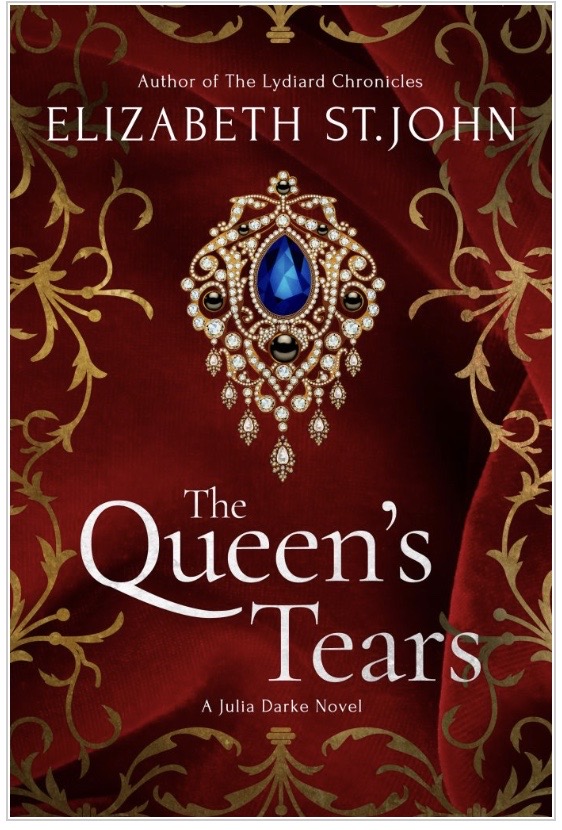
The Queen’s Tears
“We question nothing in these times,” she says. “We women are emerging from the shadows, and oneday we will be known for who we are, for the art we have created. One day, in the future, womenwill celebrate us and reveal our talents, taking us into the light. They will find our hidden marks, tell our lost stories. Omnia amissa iterum invenietur.”
“All that is lost will be found again.”
THE QUEEN’S TEARS
A true witches’ brew—a night of thunder and lightning—opens the door to the death of Anne of Denmark. As she lies dying, with not one member of her family by her side, a select group of household servants gathers her jewels. Anne (or Anna) is the wife of James I of England, who is also James VI of Scotland.
It is a dark scene, made darker by grave robbing. The jewels are supposed to be going, at the wishes of the queen, to a French Catholic religious order to ensure the salvation of her soul, but many of these treasures are earmarked for another destiny. One is taken by one of the story’s main characters: Barbara Villiers, sister-in-law of George Villiers, the then Marquess of Buckingham and favourite of King James. Barbara is a true female courtier, a woman determined to see her family rise and take their rightful place at court. But to achieve that, she needs wealth—and her brother-in-law desires enough of these jewels to add to his own fortune. Barbara believes that this includes her family’s fortune too.
When the queen at last dies, Barbara succumbs to temptation and takes an ornate ivory box as payment for overseeing the questionable actions of the other servants, as well as her own, and that of her ambitious brother-in-law. Inside, she later finds a beautiful diamond-shaped brooch embedded with black pearls. A large sapphire sparkles in its centre and diamonds dangle from its sides like tears. It is a priceless jewel—one given by a daughter to her beloved mother when life separated them. Soon, loss and sorrow make Barbara to believe that she has a right to possess it.
The jewel haunts the story, both in Barbara’s narrative and Julia’s narrative in the present-day. Julia has returned home to England to rebuild her life after the collapse of her marriage and is writing a novel about Barbara’s daughter, Anne Douglas, Lady Dalkeith. Now the owner of a second-hand bookshop in Oxford, she discovers, while researching, what appears to be a copy of a portrait of Barbara. She decides that she wants to buy it—and, in doing so, turns her life upside down.
St John’s storytelling is always a delight to read. Her characters are so well drawn that they live and breathe on the page. The breadth and depth of her research weave the past into a rich tapestry of vivid colour and verisimilitude. She skilfully opens a door for the reader into both the seventeenth century and the present day. She also writes beautifully:
They reached College Gardens from Raheen Road, passed through the gate set into the old wall, and stopped.
The gardens ran in terraces down the slope, the town walls rising above, the estuary visible below through the still-bare trees, buds barely bumping on the laced branches. The walls were old and uneven but still standing proud, witnesses to sieges and battles and threats from near and far. These stones had been here before Barbara. They would remain long after Julia. The garden simply continued, as growing things do.
Like St John’s The King’s Intelligencer, this novel sets out to solve a mystery. But at the heart of The Queen’s Tears is a tale of loss: Barbara’s losses and Julia’s losses. It also reminds us that lost things can be rediscovered. When they are, our lives are made anew.